Scalp Cooling for Chemotherapy Hair Loss: The 2026 Guide
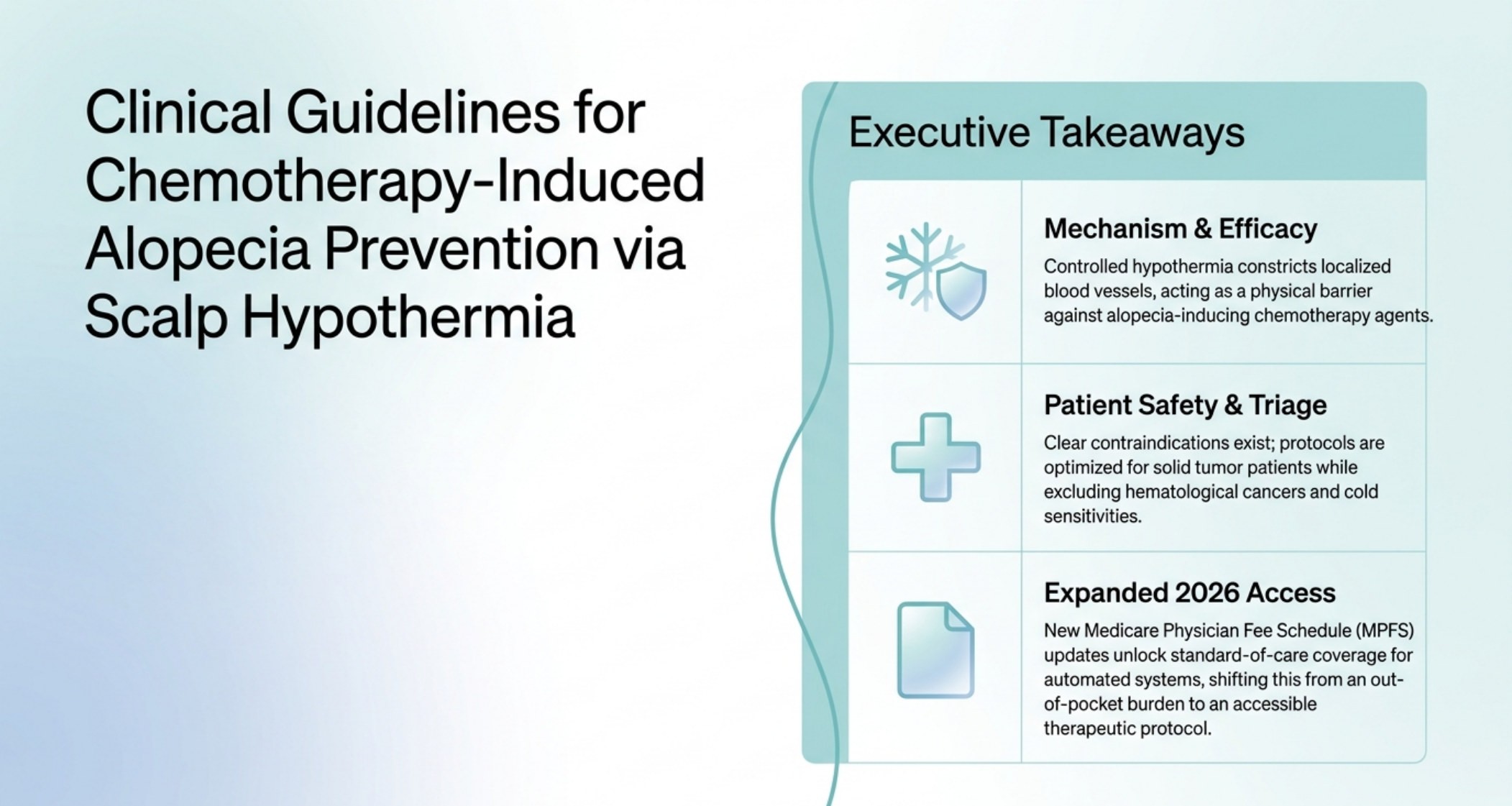
Scalp cooling preserves hair on standard chemotherapy agents by holding the scalp at a lowered temperature so constricted vessels limit how much drug reaches the follicle — but the technique fails by design in three situations: blood and lymph cancers, central nervous system cancers or skull radiation, and immunotherapy or targeted-drug regimens. The access picture shifted on January 1, 2026, when the Medicare Physician Fee Schedule began covering mechanical scalp cooling for FDA-cleared automated systems, converting a previously out-of-pocket expense into a structured benefit. For patients in Cary and across North Carolina, the practical question is no longer whether the technology exists, but whether their tumor type, drug regimen, and cold tolerance clear triage.
What controlled hypothermia actually does to the follicle
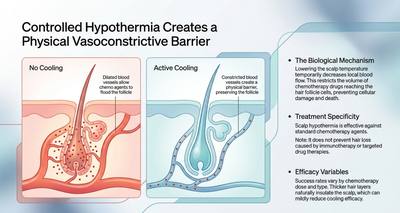
Lowering scalp temperature temporarily decreases local blood flow. Constricted vessels act as a physical barrier, restricting the volume of chemotherapy agents that reach the hair follicle cells and preventing the cellular damage and death that produce visible shedding. The mechanism is vascular, not follicular: cooling does not stimulate growth and does not repair a follicle already damaged by an earlier cycle — it reduces the drug dose that follicle receives during infusion.
Two boundaries define where that mechanism applies. Scalp hypothermia works against standard chemotherapy agents but does not prevent hair loss caused by immunotherapy or targeted drug therapies, so a patient on those regimens should not expect protection from a cold cap. Success rates also vary by chemotherapy dose and type, which means a protocol that preserves hair on one regimen may only partially cover another. Thicker hair layers naturally insulate the scalp, mildly reducing cooling efficacy — a trade-off that matters more for patients with dense hair than most summaries admit. The physiology is covered in more depth in our clinical hair regrowth science breakdown.
| State | Vessel behaviour | Effect at the follicle |
|---|---|---|
| No cooling | Dilated blood vessels | Chemotherapy agents flood the follicle during infusion |
| Active cooling | Constricted blood vessels | Physical barrier restricts drug volume reaching the follicle cells |
| Net result | Reduced local perfusion | Preserves the follicle by preventing cellular damage and death |
Who passes triage — and who the protocol excludes
Exclusions are absolute rather than advisory. Hematological cancers — leukemia, lymphoma, and multiple myeloma — are ruled out because cancer cells circulating in the blood and lymph systems must not be shielded from chemotherapy. The cooling barrier that protects a follicle would, in those diseases, protect the target the drug is meant to reach.
A second exclusion covers central nervous system cancers and any patient with previous or planned radiation therapy to the skull; preparation for bone marrow or stem cell transplants is excluded for the same reason. A third covers cold-sensitivity conditions — cold-agglutinin disease, cryoglobulinemia, and post-traumatic cold dystrophy — where cooling carries severe toxicity risks.
Metabolic and age thresholds close the list. Severe liver problems dangerously alter chemotherapy clearance times, and pediatric patients under 18 are excluded because approved studies in that group do not exist. Protocols are therefore optimized for solid tumor patients. One reassurance is worth stating plainly: the data shows no increased risk of scalp metastases from cooling. Of the five commonly reported side effects — transient headaches, nausea, dry skin, feeling cold, and mild claustrophobia — none changes the oncologic picture. Anyone weighing eligibility against a specific regimen should start with our frequently asked questions page before discussing timing with an oncology team.
| Exclusion category | Examples | Reason it disqualifies |
|---|---|---|
| Hematological cancers | Leukemia, lymphoma, multiple myeloma | Blood and lymph cancer cells must not be shielded from chemotherapy |
| Radiation & CNS | CNS cancers; prior or planned skull radiation; bone marrow or stem cell transplant prep | Shielding the treatment field undermines therapy |
| Cold sensitivity | Cold-agglutinin disease, cryoglobulinemia, post-traumatic cold dystrophy | Severe toxicity risk from cooling |
| Metabolic & age | Severe liver problems; pediatric patients under 18 | Altered drug clearance; no approved studies under 18 |
The January 1, 2026 Medicare access change
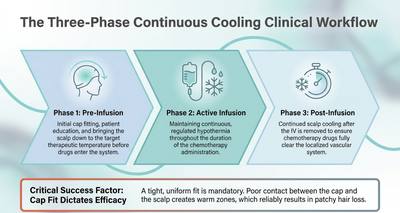
Effective January 1, 2026, Medicare provides structural coverage for mechanical scalp cooling through the Physician Fee Schedule. Coverage includes the initial cap fitting and clinical patient education, pre-infusion cooling sessions, and post-infusion cooling sessions billed in 30-minute increments. What that means in practice is that the labor of a properly run protocol — fitting, education, and the post-infusion tail — is now payable rather than absorbed by the patient.
The regulatory constraint is the decisive line. Coverage applies exclusively to FDA-approved, automated scalp cooling systems; manual frozen caps are excluded. A patient who arrives with a freezer-cooled gel cap is outside the benefit entirely, regardless of clinical need.
For underinsured patients, nonprofit assistance through HairToStay and The Rapunzel Project fills gaps the fee schedule does not. The net effect is that scalp hypothermia has moved from a prohibitive out-of-pocket expense to a standardized, accessible part of oncological care. Cary patients comparing programs can check the hair restoration cost guide for how coverage and self-pay numbers are typically structured.
| Covered item | Detail | Constraint |
|---|---|---|
| Initial cap fitting + education | Clinical fitting and patient instruction | Must use an FDA-approved automated system |
| Pre-infusion cooling | Session before drugs enter the system | Manual frozen caps excluded from coverage |
| Post-infusion cooling | Continued cooling after IV removal | Billed in 30-minute increments |
Automated systems versus manual frozen caps
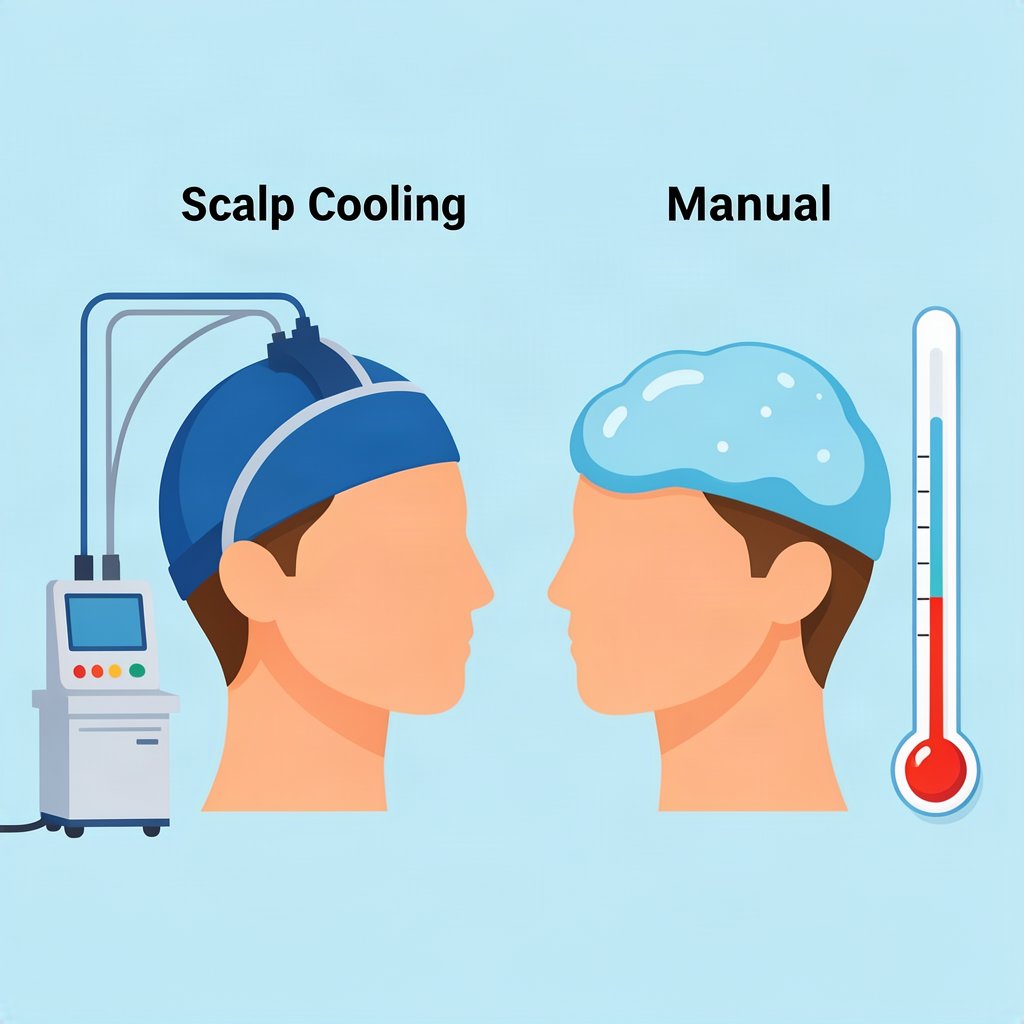
The technology class decides most of the outcome. Automated systems — the FDA-cleared DigniCap, Paxman, and Amma — circulate liquid or gel by machine to maintain a continuous, precise therapeutic temperature, and a single cap is worn for the entire three-phase protocol. That continuity is the clinical point: temperature never drifts during infusion.
Manual gel caps are an older technology. They are non-regulated, cooled via freezer or dry ice, start excessively cold, and warm rapidly on scalp contact. Because they cannot hold temperature, they require a manual swap to a new frozen cap every 30 minutes, and they carry a documented risk of scalp thermal injury, which is why an inner protective band is often used. The table below sets the two classes side by side.
| Factor | Automated systems | Manual gel caps |
|---|---|---|
| Technology class | Gold standard; FDA-cleared (DigniCap, Paxman, Amma) | Outdated; non-regulated frozen gel caps |
| Temperature control | Machine-circulated liquid or gel holds a continuous, precise therapeutic temperature | Starts excessively cold, warms rapidly on scalp contact |
| Clinical workflow | One cap worn continuously for the entire three-phase protocol | Manual swap to a new frozen cap every 30 minutes |
| Safety profile | Highly regulated thermal safety | Documented risk of scalp thermal injury; often needs an inner protective band |
Side effects, safety data, and the limits of the evidence
The tolerability profile is the reason the protocol is practical at all. Transient headaches, nausea, dry skin, feeling cold, and mild claustrophobia are reported as manageable and non-exclusionary; none of the five requires stopping treatment. The widely repeated concern — that cooling the scalp could shelter circulating cancer cells and raise metastasis risk — is answered by the data showing no increased risk of scalp metastases from cooling, which is why the exclusions target specific diseases rather than the technique itself.
The limits are equally specific. Cooling protects against standard chemotherapy agents and stops there; it offers no benefit against immunotherapy or targeted drug therapies. Its effectiveness varies with dose and agent, and thick hair can mildly reduce how much cooling the follicle actually receives. For a Cary patient deciding whether to pursue it, the honest bottom line is this: it is a well-tolerated, increasingly covered, mechanism-driven protocol for solid tumor patients on standard chemotherapy, and a non-starter for the excluded groups above.
This article is educational information, not medical advice, and a qualified provider should assess the individual case before any decision is made.
Frequently Asked Questions
Does scalp cooling work for every type of chemotherapy?
No. It is effective against standard chemotherapy agents, but it does not prevent hair loss caused by immunotherapy or targeted drug therapies, and success rates vary by chemotherapy dose and type.
Is scalp cooling covered by Medicare in 2026?
Yes, with a condition. Starting January 1, 2026, the Medicare Physician Fee Schedule covers initial cap fitting and patient education, pre-infusion sessions, and post-infusion sessions billed in 30-minute increments — but only for FDA-approved automated systems. Manual frozen caps are excluded.
Who should not use scalp cooling?
Patients with hematological cancers such as leukemia, lymphoma, or multiple myeloma; CNS cancers or prior or planned skull radiation; bone marrow or stem cell transplant preparation; cold-sensitivity conditions including cold-agglutinin disease and cryoglobulinemia; severe liver problems; and pediatric patients under 18.
Get matched with hair restoration professionals →
Ready for a Professional Review?
We can connect you with qualified hair restoration professionals who can map your situation to the right treatment.
Get Matched with Hair Restoration Professionals