Scalp Hypothermia: The Vasoconstrictive Barrier Explained
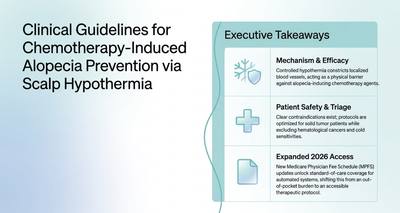
Scalp hypothermia is not a cosmetic trick layered on top of chemotherapy — it is a controlled vasoconstriction protocol, and its entire protective value comes from one vascular event: lowering scalp temperature constricts local blood vessels, restricting the volume of chemotherapy agents that reach the follicle cells. Read the mechanism correctly and every clinical rule that surrounds it becomes predictable, from why blood cancers are excluded outright to why cap fitting is treated as therapy rather than setup. For Cary patients trying to understand what a cold cap is actually doing during an infusion, the honest answer is that it builds a temporary physical barrier, not a permanent one.
Vasoconstriction is the whole mechanism
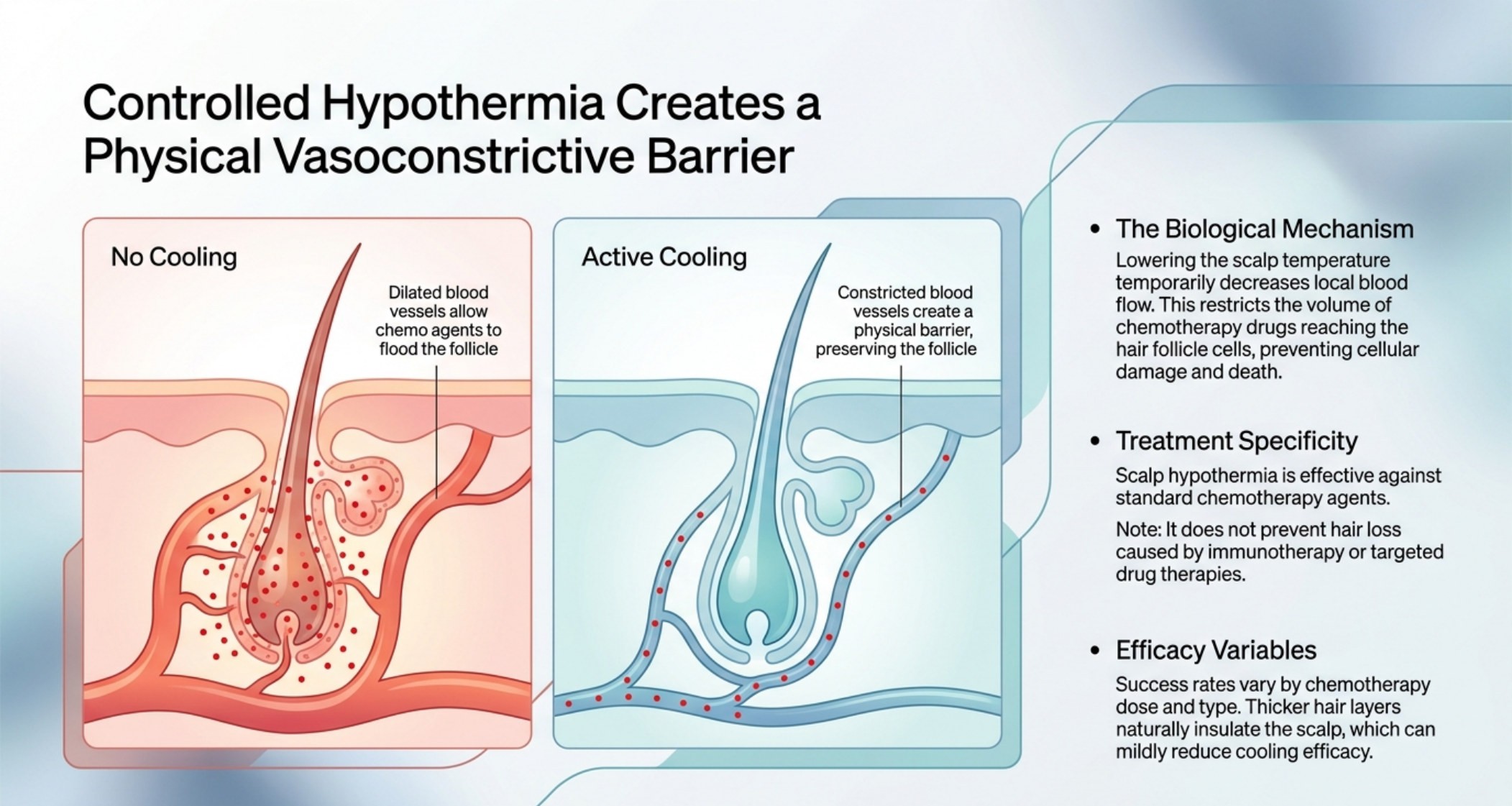
In the uncooled scalp, dilated blood vessels allow chemotherapy agents to flood the follicle during infusion. Active cooling reverses that state: constricted vessels form a physical barrier, and the reduced perfusion limits how much drug reaches the follicle cells. The consequence is measured in cell survival — less agent delivered means less cellular damage and less cell death, which is what a patient experiences as retained hair rather than shedding.
Two properties of that barrier matter. It is temporary, existing only while the scalp is held at the lowered temperature, and it is local, confined to the tissue under the cap. Cooling does not alter systemic chemotherapy exposure, which is why the oncologic treatment itself is unaffected and why the documented metastasis concern has been addressed: the data shows no increased risk of scalp metastases from cooling. Our clinical science behind follicle regrowth explains how the same follicle-cell biology behaves in non-chemotherapy hair loss.
| Scalp state | Vessel behaviour | Volume of chemo reaching follicle | Follicle outcome |
|---|---|---|---|
| No cooling | Dilated blood vessels | High — agents flood the follicle | Cellular damage and death; shedding |
| Active cooling | Constricted blood vessels | Low — physical barrier restricts flow | Follicle structure preserved |
| After cooling stops | Vessels return toward baseline | Returns toward baseline | Barrier ends; no residual protection |
Why the barrier only works on standard chemotherapy agents
The specificity of the technique follows directly from the mechanism. Scalp hypothermia is effective against standard chemotherapy agents, and it does not prevent hair loss caused by immunotherapy or targeted drug therapies. A patient whose regimen relies on those drug classes will not be protected by cooling no matter how well the cap is fitted, because the pathway being exploited — restricting blood-borne drug delivery — is not the pathway those agents use to affect the follicle.
This is the single most common misunderstanding, and it reframes the eligibility conversation. Cooling is not a general hair-loss insurance policy; it is a targeted intervention for a defined drug class. The practical trade-off is that a patient may be an excellent candidate for the physical protocol and still outside its benefit because the agent in the IV bag is the wrong class.
| Regimen type | Does cooling help? | Reason tied to mechanism |
|---|---|---|
| Standard chemotherapy agents | Yes | Drug delivery is blood-borne, so constriction limits the volume reaching the follicle |
| Immunotherapy | No | Hair loss pathway is not the blood-borne delivery that cooling restricts |
| Targeted drug therapies | No | Not prevented by scalp hypothermia |
Efficacy variables: dose, agent, and hair thickness
When cooling does apply, three variables set the ceiling on results. Success rates vary by chemotherapy dose and type, so the same protocol run identically on two patients can produce different degrees of preservation. Thicker hair layers naturally insulate the scalp, which can mildly reduce cooling efficacy — the barrier is only as good as the temperature actually reaching the skin, and a dense hair layer sits between the cap and the scalp it needs to chill.
The practical reading is that Cary patients should treat predicted outcome as a range, not a guarantee. Dose and agent are fixed by the oncology plan and cannot be traded away; hair thickness is a personal variable a patient can physically manage by arriving with the scalp as accessible to the cap as possible. Between those two, the controllable factor is contact, not chemistry.
Cap fit: the warm-zone failure mode
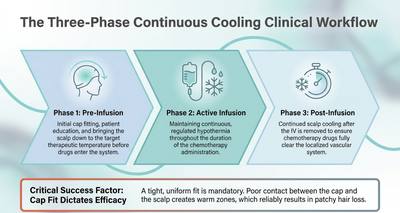
A tight, uniform fit is mandatory, and this is the protocol's sharpest mechanical rule: poor contact between the cap and the scalp creates warm zones, which reliably results in patchy hair loss. The mechanism explains the consequence. A warm zone is an uncooled patch, and an uncooled patch keeps dilated vessels and full drug delivery, so the follicle beneath it behaves exactly as it would with no cooling at all — while neighbouring, well-chilled zones are protected.
That asymmetry is why partial results often appear as patches rather than uniform thinning, and why fitting is treated as clinical work rather than an accessory choice. It is also why the 2026 coverage rules pay for initial cap fitting and clinical patient education as distinct covered items: from a mechanism standpoint, the fitting is not setup, it is part of the therapy.
| Fit quality | Contact between cap and scalp | Vascular state under cap | Hair outcome |
|---|---|---|---|
| Tight, uniform | Full contact across the treatment field | Constricted vessels throughout | Preservation across the entire cooled area |
| Loosely fitted | Poor contact creates warm zones | Dilated vessels in the warm zones | Patchy hair loss wherever zones form |
What the 2026 coverage rules reveal about the mechanism
Coverage policy now mirrors the physics. Effective January 1, 2026, the Medicare Physician Fee Schedule provides structural coverage for mechanical scalp cooling, and it pays for initial cap fitting and clinical patient education, pre-infusion cooling sessions, and post-infusion cooling sessions billed in 30-minute increments. Those are precisely the steps that maintain the barrier across the whole treatment window rather than only during the infusion itself.
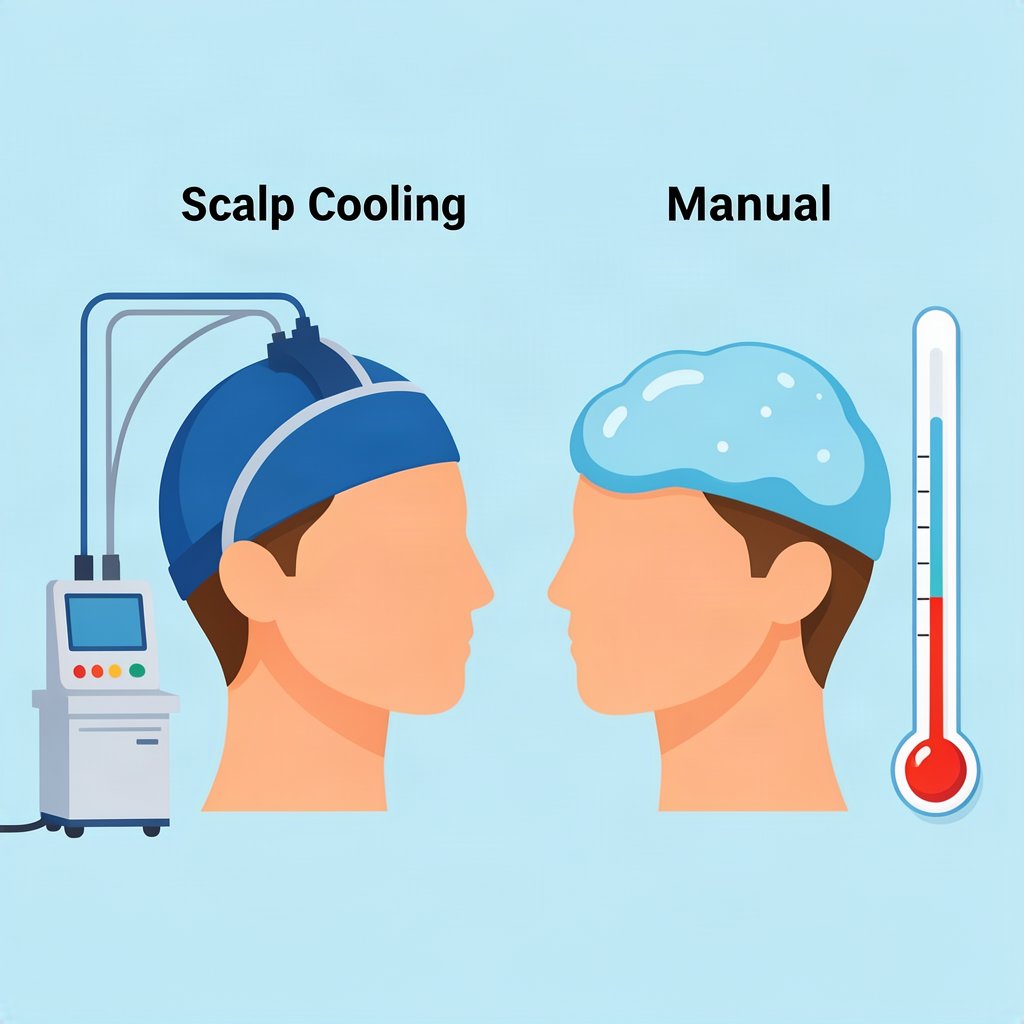
The regulatory constraint is equally mechanism-driven. Coverage applies exclusively to FDA-approved automated scalp cooling systems such as DigniCap, Paxman, and Amma, which use machine-circulated liquid or gel to hold a continuous, precise therapeutic temperature; manual frozen gel caps are excluded. A freezer-cooled cap starts excessively cold and warms rapidly on contact, then requires a swap every 30 minutes — temperature that drifts below the therapeutic target breaks the barrier intermittently. For underinsured patients, HairToStay and The Rapunzel Project provide financial assistance, and North Carolina patients can compare the two technology classes on our side-by-side comparisons page.
| Covered item | Billing structure | Mechanism it sustains |
|---|---|---|
| Initial cap fitting + education | Covered procedure | Eliminates warm zones so the barrier is uniform |
| Pre-infusion cooling | Covered session | Reaches target temperature before drugs enter the system |
| Post-infusion cooling | Billed in 30-minute increments | Holds the barrier while drugs clear the local vascular system |
It is worth restating what the mechanism does not claim: it does not repair a follicle already damaged, it does not protect against immunotherapy or targeted agents, and its measured success varies with dose and agent type. This article is educational information, not medical advice, and a qualified provider should assess the individual case.
Frequently Asked Questions
How does scalp cooling actually prevent hair loss?
Controlled hypothermia constricts localized blood vessels, acting as a physical barrier that restricts the volume of chemotherapy agents reaching the hair follicle cells and preventing cellular damage and death.
Does a poorly fitted cap reduce results?
Yes. A tight, uniform fit is mandatory; poor contact creates warm zones, and warm zones reliably produce patchy hair loss because the follicle beneath them receives full drug delivery.
Why are manual frozen caps excluded from 2026 Medicare coverage?
Because they cannot hold a continuous therapeutic temperature. Coverage applies exclusively to FDA-approved automated systems; manual gel caps start excessively cold, warm rapidly on contact, and require swapping to a new frozen cap every 30 minutes.
Get matched with hair restoration professionals →
Ready for a Professional Review?
We can connect you with qualified hair restoration professionals who can map your situation to the right treatment.
Get Matched with Hair Restoration Professionals