The Three-Phase Scalp Cooling Workflow
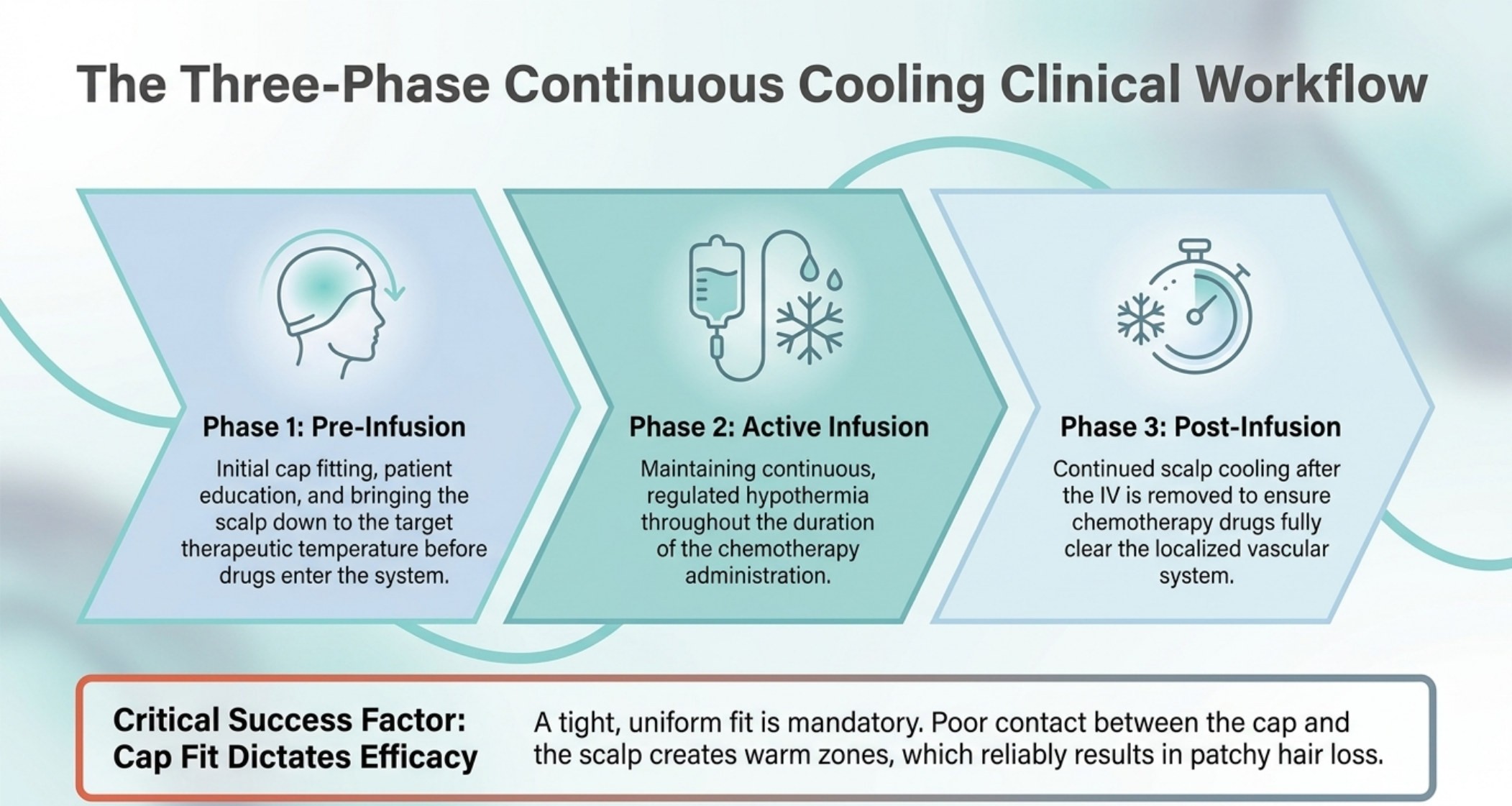
The scalp cooling protocol that preserves hair is not a single act of putting on a cold cap — it is a three-phase sequence, and the two phases that surround the infusion exist for one reason: the chemotherapy drug is present in the local vascular system before the IV starts and after it is removed. Skip the pre-infusion phase and the follicle is exposed during an unprotected window; skip the post-infusion phase and residual drug clears through vessels that are no longer constricted. One mechanical failure dominates all others in reported outcomes — poor cap contact. A tight, uniform fit is mandatory, because poor contact between the cap and the scalp creates warm zones that reliably produce patchy hair loss. Cary patients heading into a first cycle should understand the sequence, the timing rules, and which phase the 2026 billing structure treats as a measured unit of care.
Phase 1: pre-infusion — reach temperature before the drug arrives
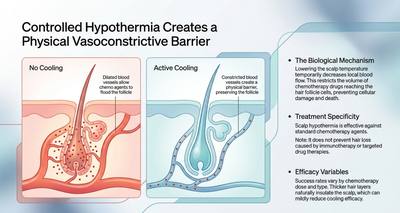
The first phase is initial cap fitting, patient education, and bringing the scalp down to the target therapeutic temperature before the drugs enter the system. The ordering is the entire point. Controlled hypothermia works by constricting blood vessels so they act as a physical barrier against alopecia-inducing chemotherapy agents; if cooling begins after the agent is already circulating, the follicle absorbs that first exposure through dilated vessels, and no amount of later cooling retrieves it.
This creates a real scheduling trade-off. The pre-infusion phase extends the appointment beyond the infusion itself, because reaching the target temperature takes time that the chemotherapy administration does not. That added time is precisely why it appears as a separately covered item under the 2026 Medicare Physician Fee Schedule, alongside the initial cap fitting and clinical patient education — the workflow is being paid for as clinical work, not as an accessory.
| Phase | Patient and clinical action | What must be true |
|---|---|---|
| Phase 1: pre-infusion | Initial cap fitting, patient education, scalp brought down to target therapeutic temperature | Target temperature reached before drugs enter the system |
| Phase 2: active infusion | Continuous, regulated hypothermia maintained | No drift back toward baseline during chemotherapy administration |
| Phase 3: post-infusion | Cooling continues after the IV is removed | Barrier held until drugs fully clear the localized vascular system |
Phase 2: active infusion — holding a continuous regulated window
The middle phase is maintaining continuous, regulated hypothermia throughout the duration of chemotherapy administration. Both words carry weight. "Continuous" means the scalp must not return toward baseline at any point during the infusion, because every minute spent warm is a minute of constricted-then-dilated fluctuation the follicle experiences as exposure. "Regulated" means the temperature is held at the therapeutic target rather than simply made as cold as possible.
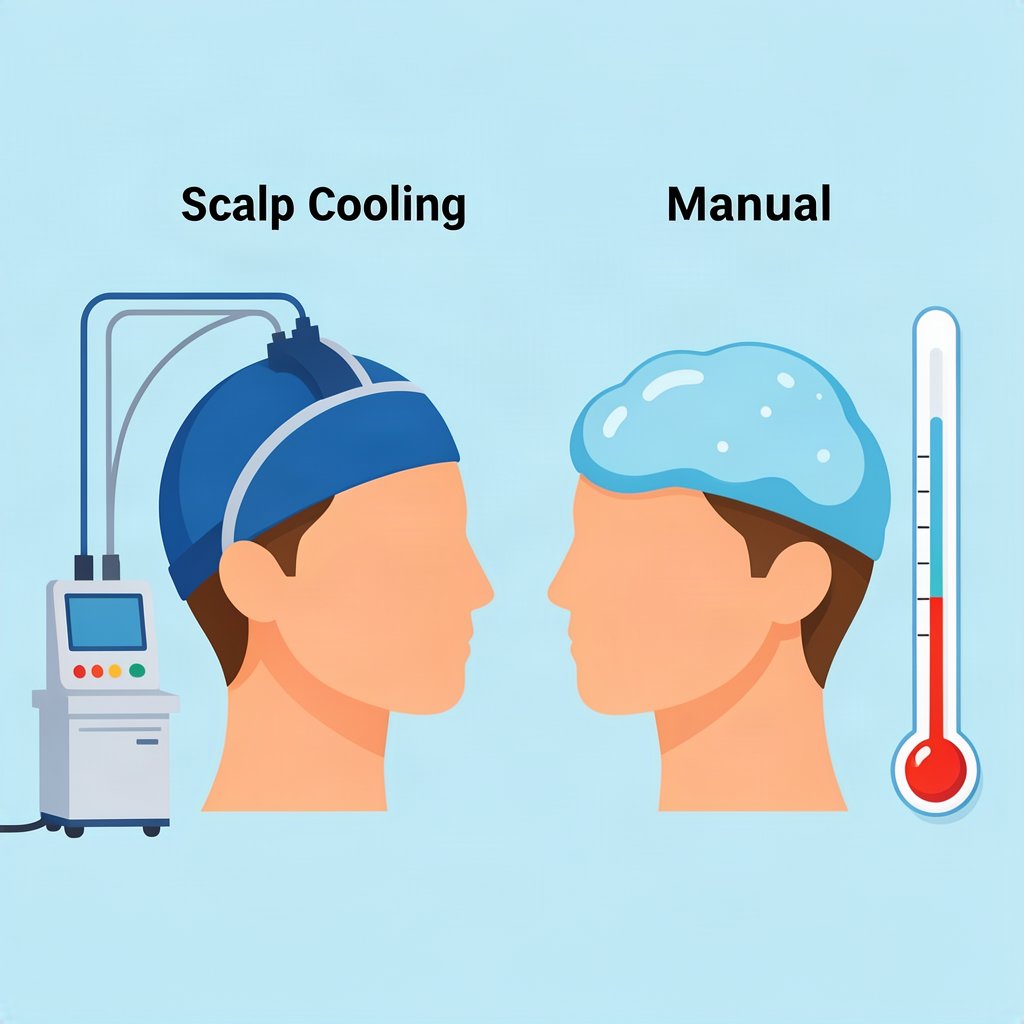
This is where the technology class diverges sharply. Automated systems hold a continuous, precise therapeutic temperature by machine-circulating liquid or gel, and a single cap is worn for the entire three-phase protocol, so there is no interruption at the handoff between phases. Manual gel caps cannot do this. A freezer-cooled cap starts excessively cold and warms rapidly upon scalp contact, so the infusion phase becomes a relay of manual swaps every 30 minutes — and each swap is a moment when the regulated window is broken.
Phase 3: post-infusion — clearing the local vascular system
The final phase is continued scalp cooling after the IV is removed, to ensure chemotherapy drugs fully clear the localized vascular system. The mechanism is straightforward: infusion ending does not mean the agent has left the tissue. Drug remaining in local circulation still has to pass the follicle, and if the vessels have already reopened, that last volume reaches the follicle unimpeded. The post-infusion phase holds the barrier until clearance is complete.
The billing structure reflects how real that tail is. Under the coverage effective January 1, 2026, post-infusion cooling sessions are billed in 30-minute increments, meaning the clearance tail is treated as a quantifiable unit of care rather than an afterthought. Coverage applies exclusively to FDA-approved automated scalp cooling systems — DigniCap, Paxman, and Amma — while manual frozen caps are excluded entirely. Underinsured patients in North Carolina can turn to nonprofits such as HairToStay and The Rapunzel Project. The mechanics of each phase are broken down further on our how the process works page.
| Item | Structure under the 2026 fee schedule | Workflow implication |
|---|---|---|
| Initial cap fitting + education | Covered | Fitting is treated as clinical work, not setup |
| Pre-infusion cooling | Covered session | Time spent reaching target temperature is payable |
| Post-infusion cooling | Billed in 30-minute increments | The clearance tail is a measured unit of care |
| Eligible technology | FDA-approved automated systems only | Manual frozen caps are excluded from coverage |
Cap fit dictates efficacy in all three phases
The protocol's critical success factor is identical across every phase: a tight, uniform fit. Poor contact between the cap and the scalp creates warm zones, and those zones reliably result in patchy hair loss. The phase sequence does not rescue a badly fitted cap — a warm zone is uncooled in phase one, uncooled through the infusion, and still uncooled while the drug clears.
The result is the characteristic partial outcome: not uniform thinning, but preservation in the well-contacted areas and loss in the poorly contacted ones. Practical consequences follow. Cary patients should expect fitting to be a deliberate clinical step rather than a quick accessory adjustment, and anyone managing thick hair should recognise that thicker hair layers naturally insulate the scalp, which can mildly reduce cooling efficacy even with good contact. Together, fit and hair layer are the two physical variables a patient can influence before the appointment starts.
| Factor | Automated systems | Manual gel caps |
|---|---|---|
| Technology class | Gold standard; FDA-cleared (DigniCap, Paxman, Amma) | Outdated; non-regulated frozen gel caps |
| Temperature control | Machine-circulated liquid or gel holds a continuous, precise therapeutic temperature | Starts excessively cold, warms rapidly upon scalp contact |
| Workflow across three phases | One cap worn continuously for the entire protocol | Manual swap to a new frozen cap every 30 minutes |
| Safety profile | Highly regulated thermal safety | Documented risk of scalp thermal injury; often needs an inner protective band |
Automated and manual workflows fail in different places
Comparing the two technology classes by workflow rather than by price clarifies the choice. Automated systems are the gold standard: FDA-cleared, machine-circulated, carrying highly regulated thermal safety, and running as one continuous cap across all three phases. Their failure mode is essentially logistical — the system must be available at the treatment site and fitted well.
Manual gel caps are outdated technology with a different failure profile. They are non-regulated, cooled via freezer or dry ice, start excessively cold, warm rapidly on contact, and require a swap to a new frozen cap every 30 minutes, which means the infusion phase is interrupted repeatedly. They also carry a documented risk of scalp thermal injury, often requiring an inner protective band to be worn. The workflow comparison, not marketing positioning, is what separates the two classes, and our technology comparisons lays the classes out side by side.
Two boundary conditions apply to the whole sequence. The protocol is optimised for solid tumor patients on standard chemotherapy agents, and it does not prevent hair loss caused by immunotherapy or targeted drug therapies. Success rates also vary by chemotherapy dose and type. Manageable, non-exclusionary side effects include transient headaches, nausea, dry skin, feeling cold, and mild claustrophobia, and the data shows no increased risk of scalp metastases from cooling. This article is educational information, not medical advice, and a qualified provider should assess the individual case.
Frequently Asked Questions
Why does cooling start before the chemotherapy infusion?
Because the barrier has to exist before the drug arrives. The pre-infusion phase brings the scalp down to the target therapeutic temperature so the follicle cells are protected by vasoconstriction the moment chemotherapy agents enter the system.
How long after the IV is removed does cooling continue?
Post-infusion cooling continues until the chemotherapy drugs fully clear the localized vascular system. Under coverage effective January 1, 2026, these sessions are billed in 30-minute increments, which reflects that the clearance tail is a real unit of care.
Can a manual frozen gel cap run the full three-phase protocol?
Only with interruptions. A manual cap warms rapidly upon scalp contact and must be swapped for a new frozen cap every 30 minutes. FDA-approved automated systems instead hold one cap continuously at a precise therapeutic temperature for the entire protocol, and manual caps are excluded from 2026 Medicare coverage.
Get matched with hair restoration professionals →
Ready for a Professional Review?
We can connect you with qualified hair restoration professionals who can map your situation to the right treatment.
Get Matched with Hair Restoration Professionals